
Country
France
Region/Province
Vaucluse (Mazan), Southeastern France
River basin
Rhône basin
Length
35km
Main features
Rural–periurban river affected by hydraulic works and flood risks. Restoration of 500 m of the watercourse seeks to recover natural dynamics and community access.
In 1992, the Ouvèze River in southeastern France experienced a devastating flood that struck the town of Vaison-la-Romaine, causing numerous casualties. This event deeply affected the residents along the river as well as those in neighboring watersheds. Among these waterways is the Auzon, a river flowing at the foot of Mont Ventoux, which has been significantly altered over time by a series of historical developments, including mills and weirs, irrigation canals, downstream dredging and raised riverbeds, embankments, and channel straightening. For several decades, management of the Auzon River has focused on flood protection through dredging, embankment and sediment removal from the riverbed.
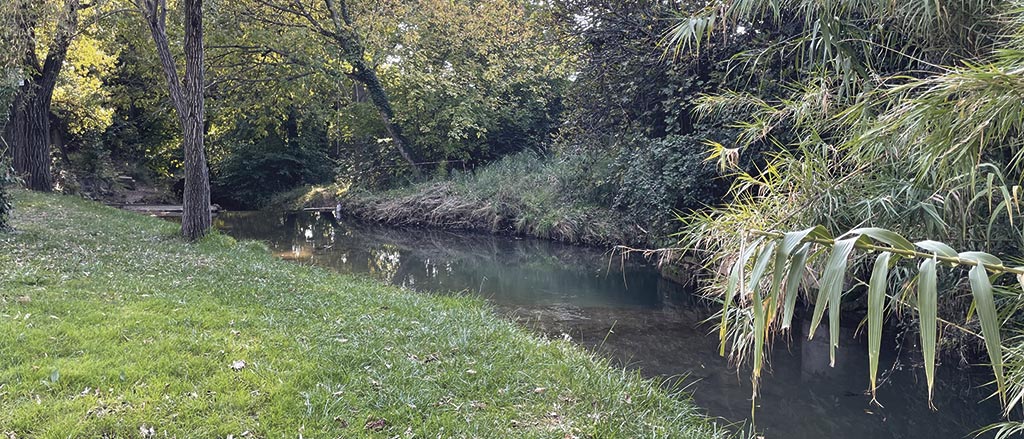
Flowing through the center of the village of Mazan (over 6,000 inhabitants), the Auzon River today illustrates the cumulative effects of successive human interventions. Increasing soil impermeability, channeling of the river, disruption of ecological continuity by a weir, restricted access to the banks, and confinement of the riverbed between roads are among the challenges inherited from past hydraulic developments and management practices. For the EPAGE Mont Ventoux, the current managers of the river, flood management and ecological restoration of the Auzon in Mazan have gradually become essential. They therefore sought to involve residents in co-constructing restoration scenarios.
Between 2022 and 2023, a consultation process supported by a multidisciplinary team of scientists was carried out as part of the Resteau’débat research project . Sociological surveys and participatory workshops conducted during this period revealed an ambivalent perception of the river. Residents perceived it as less appealing than in the past and potentially dangerous, due to flooding and bank erosion. Yet a strong attachment persist, particularly to a weir, appreciated for its sound and for supplying water to historic canals that irrigate Mazan’s gardens in summer.
Considering options to lower or remove the weir – measures viewed as necessary to restore ecological continuity and ensure flow in the Auzon during severe droughts – generated tensions and mistrust toward institutions and scientists. Nevertheless, the participatory workshops enabled the co-construction of several restoration scenarios, strengthened (and sometimes initiated) dialogue among residents, managers, and elected officials, and brought local controversies to light. These exchanges highlighted social concerns and resistance, which today represent the main obstacles to implementing an ambitious ecological restoration project on the Auzon in Mazan.
Building on the work initiated by Resteau’débat, the RiVIVE project aims to ensure that the restauration of the Auzon – scheduled to begin in 2027 – is not simply a technical intervention by engineers. Instead, it seeks to make restoration a co-constructed process, using controversies as opportunities for collective reflection and for revitalizing territorial dialogue around water issues. To this end, the project involves schoolchildren and a local residents’ association in identifying indicators to monitor the river’s health, designing protocols, and using environmental sensors. More broadly, RiVIVE supports citizens in finding their place in restoration projects, reconnecting with the river, and taking care for it.