
Country
France
Region/Province
Lyon Metropolitan Area, Auvergne–Rhône-Alpes
River basin
Rhône basin
Length
7 km
Main features
Urban and industrial river, partly culverted and polluted. Restoration by Métropole de Lyon aims to reopen sections, depollute waters, and revitalise the social and ecological functions of the river.
The Rize is a small phreatic stream, a resurgence of the Rhône located upstream from the Lyon metropolitan area. In the past, its water quality was exceptional, thanks to natural filtration by the underlying aquifer. As early as 1866, its banks were sold to establish washing sites considered more suitable than those along the Rhône or Saône. The Rize’s clear waters also attracted numerous riverside guinguettes (open-air cafés) and various industrial activities to Vaulx-en-Velin, a town that now has more than 52,000 inhabitants. In the 19th century, dye works, laundries, and tanneries – linked to Lyon’s silk industry – flourished there. The construction of the Jonage Canal between 1892 and 1898 profoundly reshaped the local water landscape: the Rize was dredged, straightened, and its route partially modified. In the 1920s and 1930s, fish were still caught there to supply the fritures (fried fish) of the guinguettes, and until the 1950s and 1960s, local children still swam in the stream.
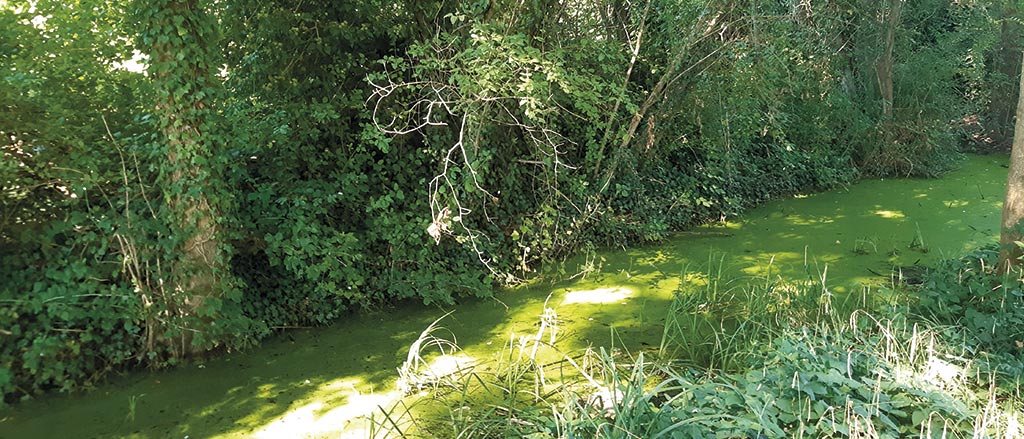
Today, however, the rapid urban development of Vaulx-en-Velin has deeply altered the Rize. Nearly 500 meters of its course now flow through underground pipes. The stream suffers from pollutant discharges, notably stormwater runoff from an industrial area. Its oversized, gently sloping bed favors the accumulation of polluted sediments and prevents natural self-purification. As a result, the ecological quality of its downstream reach has deteriorated markedly since the 1960s.
In response, and in connection with the Rhône dike refurbishment project, an initiative to restore the Rize in Vaulx-en-Velin was launched. The project aims to improve the ecological status of the stream, reduce pollution sources, and enhance residents’ quality of life. This process was carried out between 2023 and 2024 by the Resteau’débat scientific team working with the Métropole and local elected officials. A preliminary sociological survey revealed that, despite negative perceptions linked to industrial pollution and domestic waste, the Rize remains a cherished place for many residents, some of whom have formed a committee to care for and promote the stream. They regularly walk along its banks, and community gardens flourish nearby. For others, however, the Rize has become little more than a neglected memory of the past.
The restoration project has been waited for decades, and the many technical studies highlighting its necessity have only heightened residents’ impatience. This delay has fostered mistrust toward institutions, seen as inactive, while simultaneously strengthening citizens’ desire to reclaim and improve their local environment. The consultation workshops identified three main priorities—both ecological and social. The first is to reduce pollution in the stream. The second is to reconcile the different uses and social practices that coexist, and sometimes conflict, along the Rize (walking, school outings, community gardening). The third is to preserve the stream’s wild and natural character, an aspect highly valued by residents in such a densely urbanized area.
Restoration work is scheduled to begin in 2026. As part of this effort, the RiVIVE program aims to develop participatory monitoring that directly involves residents. The goal is to build a shared evaluation of the ecological and social effects of the restoration. To achieve this, the project plans to organize focus groups and dialogue spaces to bring together the many relationships people have with the Rize.
These encounters will foster new connections among long-standing and newly arrived residents, schoolchildren, students, and institutional representatives. Scientists will support participants in collectively identifying biophysical and social monitoring indicators, co-designing environmental sensors to measure them, and analysing the results. Through this approach, RiVIVE seeks to rebuild a form of riparian citizenship with and around the Rize, uniting a community of committed residents around its protection and enhancement. The project also aims to restore trust and dialogue among residents, public institutions (elected officials, river managers), and scientists by offering a non-hierarchical and open space for discussing river-related issues – bringing sensory experience, local knowledge, and scientific expertise back into conversation.