
Country
Spain
Region/Province
Province of Girona
River basin
Turia basin
Length
208 km
Main features
River running from the Pyrenees to the Mediterranean. Heavily regulated by dams and water transfers; current efforts focus on balancing water use, biodiversity, and ecological flow restoration.
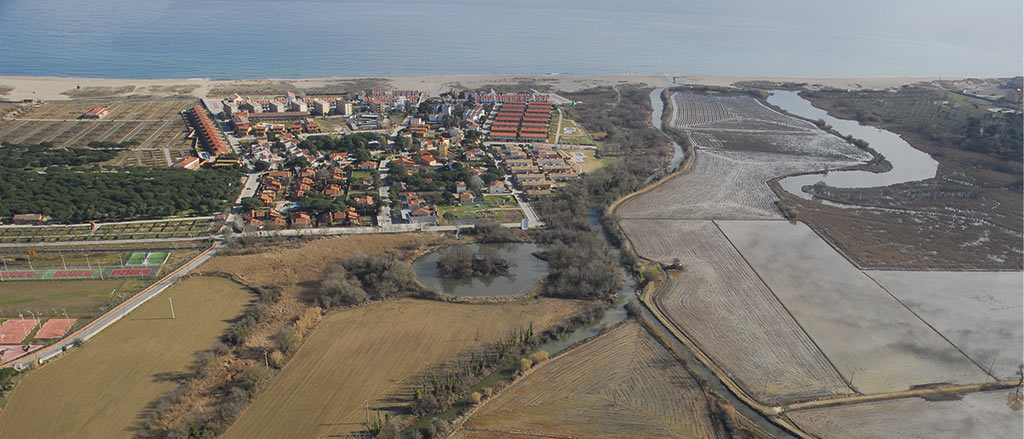
The alluvial plain of the Ter River, in Catalonia’s far northeast, is home to some of the country’s most fertile soils. Generation after generation, local communities have carefully shaped a cultural landscape now prized for its mosaic of irrigated fields, small Mediterranean woodlands, traditional farmhouses, and small towns.
The lifeblood for building this rich landscape has been the water of the Ter River, harnessed since at least the 13th century through weirs built on the river and the diversion of its flow into irrigation channels.
One of the most emblematic of these is the 13-kilometer-long Rec del Molí de Pals. It is the artery that historically allowed for the irrigation of over 3,000 hectares of fruit trees, fodder, corn, and rice on the right bank of the lower Ter. Furthermore, it was the energy source for two ancient flour mills; one, now protected, sits in the very heart of the urban center of Gualta. Over the centuries, the canal’s earthen bed became naturalized, welcoming vulnerable native flora and fauna and providing numerous ecosystem services between its origin near the Canet fluvial island wildlife reserve and its mouth at the Mediterranean Sea, now a protected natural area.
All this heritage and value, however, was profoundly altered early this century. A modernization project diverted nearly the entirety of the surface flow into a large underground pipe. The project rendered the water invisible, deeply and lastingly affecting the ecosystem, the landscape, and cultural uses.
To mitigate these impacts, changes to the canal’s management have been pushed forward, alongside specific actions for the conservation of its natural and cultural heritage. These restorative efforts, however, have been restricted in both space and time. They have been carried out by different administrations, universities, and entities without coordination or an integrated, long-term plan.
The RiVIVE project aims to harness the latent and shared desire of the lower Ter community to breathe life back into the Rec del Molí. Through the formation of a “Riparian Assembly” – a meeting space for the diversity of agents, demands and visions – the project will help to develop a joint vision for the Rec del Molí’s future multifunctional landscape, and establish the actions needed to make it a reality.