
Over the past two centuries, most rivers worldwide have been heavily transformed—dammed, diverted, polluted or dried up—leading to severe impacts on landscapes, hydrology, biodiversity, ecosystems, and human well-being. In response, river restoration has gained momentum in policy and practice, supported by global and European initiatives such as the UN Decade on Ecosystem Restoration, the EU Biodiversity Strategy (2020) and the Nature Restoration Law (2023).
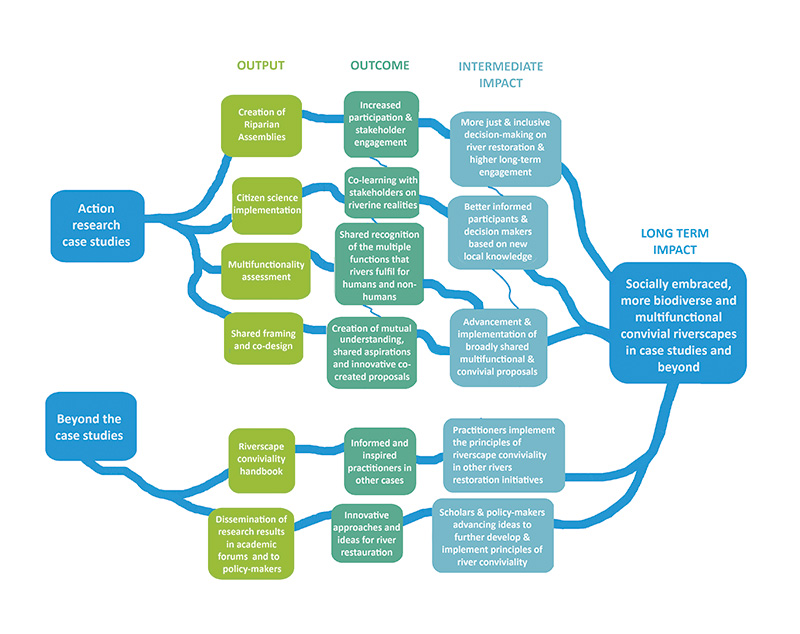
Yet, restoration projects often face strong societal contestations. Top-down, expert-driven approaches tend to overlook rivers as complex socio-ecological systems. RiVIVE aims to develop an inclusive and justice-oriented framework based on “riverscape conviviality”, acknowledging rivers as multi-valued, multifunctional and contested spaces.
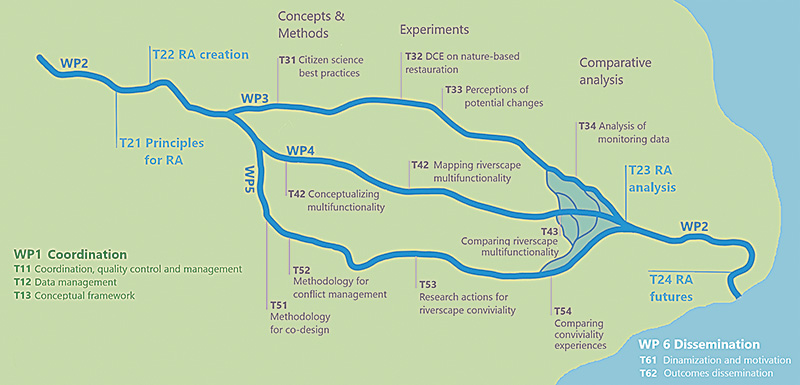
The main goal of RiVIVE is to explore how the notion of riverscape conviviality can foster more inclusive, biodiverse and socio-environmentally just river restoration practices.
Theoretical development: Elaborate the concept of riverscape conviviality to inspire academics, practitioners and stakeholders (WP1).
Alternative methodologies: Design, test and validate innovative approaches for:
Title
Duration
2024-2028
Budget
255.750€
Coordinated by
Universitat Politècnica de València
RiVIVE applies an interdisciplinary and transdisciplinary action research approach, combining natural and social sciences with local and stakeholder knowledge. Key features include:
Participatory action research via Riparian Assemblies as spaces for debate, knowledge co-creation and co-design.
Environmental justice lens addressing:
Mixed-methods approach including interviews, workshops, participatory mapping, citizen science, perception analysis, discrete choice experiments and multifunctionality assessment.